For many years, discussions about the compensation of mechanical engineers in the Philippines have often revolved around a simple question: “How do we increase salaries?”
While the concern is valid, the answer is often approached from the wrong direction.
The reality is that salary increases cannot be sustainably achieved simply by requesting them. In any profession, compensation is ultimately tied to the value delivered to employers, industries, and society. Asking for higher salaries without demonstrating increased value, capability, impact, or demand is unlikely to gain widespread support from either the private sector or government.
Before discussing salary increases, the mechanical engineering profession must first answer a more fundamental question:
How can mechanical engineers contribute more significantly to solving the country’s most pressing challenges?
Only after establishing this contribution can a strong and credible case for higher compensation be made.
The Limitation of Salary Advocacy Alone
No industry raises compensation levels merely because a professional group asks for it.
Organizations, businesses, and government agencies operate within economic realities. They pay more when a profession becomes more valuable, more specialized, more difficult to replace, and more critical to achieving organizational objectives.
Therefore, any effort to increase the salary of mechanical engineers must begin with increasing the value of the profession itself.
This is where professional organizations have a critical role to play.
The Role of Professional Organizations
Professional organizations should serve as catalysts for the advancement of the profession, not merely advocates for higher pay.
Organizations such as PSME and PSIM can contribute by:
1. Establishing Industry Compensation Benchmarks
Reliable salary surveys and compensation studies provide employers and policymakers with objective data regarding the value of mechanical engineering work.
This creates transparency and helps prevent compensation from lagging behind market realities.
2. Elevating the Value of the Profession
Professional organizations should actively demonstrate how mechanical engineers contribute to national development through infrastructure, manufacturing, energy, facilities management, sustainability, industrial productivity, and technological innovation.
The greater the perceived value of the profession, the stronger the justification for improved compensation.

3. Influencing National Policy
Mechanical engineering organizations should advocate for policies that strengthen industries where mechanical engineers play a critical role, including:
- Manufacturing
- Energy generation
- Infrastructure development
- Transportation systems
- Defense modernization
- Industrial automation
As these sectors grow, the demand for competent mechanical engineers increases, creating upward pressure on salaries.
4. Strengthening Professional Competence
Organizations must continuously improve the quality of practitioners through:
- Continuing professional development
- Technical certifications
- Specialization programs
- Research initiatives
- Knowledge-sharing platforms
Highly skilled professionals command higher compensation because their expertise is difficult to replace.
5. Encouraging Specialization
The future of engineering lies increasingly in specialized fields such as:
- Reliability engineering
- Asset management
- Energy management
- Building systems engineering
- Industrial automation
- Critical facilities management
- Data center operations
- Advanced manufacturing
By developing specialists rather than generalists, the profession becomes more valuable to employers.
6. Creating Stronger Industry Partnerships
Professional organizations should strengthen relationships with employers, investors, government agencies, and educational institutions.
These partnerships create opportunities for better employment, knowledge transfer, and career advancement.
A Proposed Roadmap for Sustainable Salary Growth
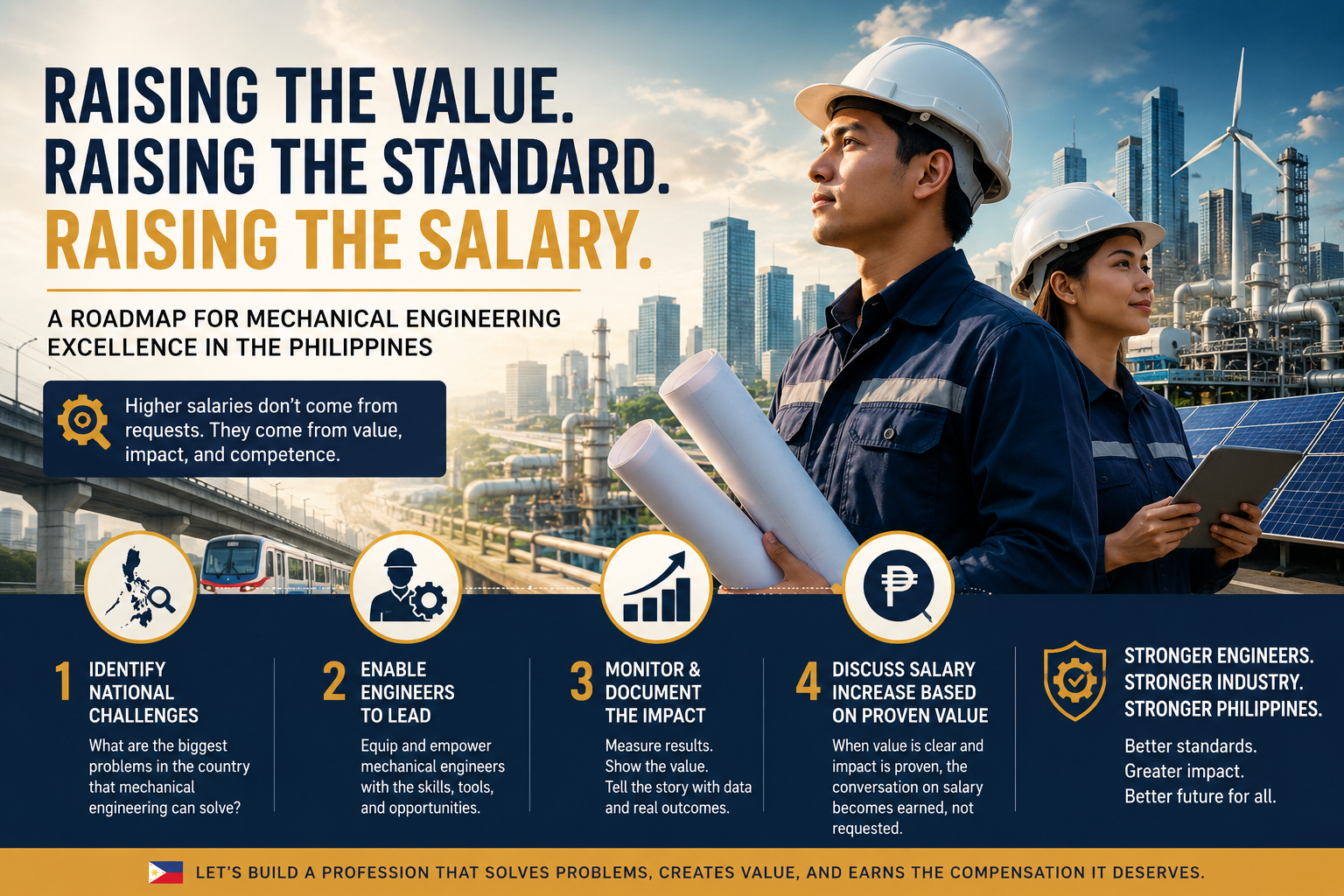
Instead of beginning with salary demands, the profession should adopt a structured roadmap.
Step 1: Identify the Nation’s Biggest Challenges That Mechanical Engineers Can Address
The first question should be:
What are the biggest problems facing the Philippines that mechanical engineers are uniquely positioned to solve?
Potential areas include:
- High energy costs
- Manufacturing competitiveness
- Aging infrastructure
- Water and wastewater systems
- Transportation efficiency
- Industrial productivity
- Climate resilience
- Facilities reliability
- Defense and national security infrastructure
Until the profession clearly defines where it can make the greatest impact, it cannot effectively demonstrate its value.
Step 2: Enable Mechanical Engineers to Solve Those Challenges
Once the challenges are identified, professional organizations, industry leaders, and academic institutions must work together to prepare engineers to address them.
This may include:
- Updating training programs
- Developing specialized certifications
- Improving technical standards
- Supporting research initiatives
- Facilitating industry-academia collaboration
- Promoting best practices
The objective is simple: equip engineers with the skills necessary to solve real national problems.
Step 3: Monitor and Document the Impact
Results must be measured.
Professional organizations should collect data demonstrating how mechanical engineers contribute to:
- Reduced energy consumption
- Increased industrial productivity
- Improved asset reliability
- Enhanced operational efficiency
- Lower maintenance costs
- Better safety outcomes
- Increased economic activity
Documented success creates evidence that the profession delivers measurable value.
Step 4: Discuss Compensation Based on Proven Value
Only after the profession can clearly demonstrate its impact should the discussion shift toward compensation.
At that point, the conversation changes from:
“Engineers deserve higher salaries.”
to
“Engineers have delivered measurable economic value, and compensation should reflect that contribution.”
This argument is far more persuasive to employers, industry leaders, and policymakers because it is supported by evidence rather than aspiration.
Beyond Salary: Raising the Standard of Mechanical Engineering
The ultimate objective should not simply be higher pay.
A profession focused solely on compensation risks losing sight of its broader purpose.
The real objective should be to elevate the practice of mechanical engineering throughout the country.
By developing stronger competencies, improving standards, solving national challenges, and demonstrating measurable impact, the profession achieves two outcomes simultaneously:
- Higher professional standards and greater public trust.
- Higher compensation driven by increased value and demand.
Salary growth then becomes a consequence of professional excellence rather than the starting point of the discussion.
Conclusion
The path to higher salaries for mechanical engineers in the Philippines is not through requests alone. Sustainable compensation growth must be built on demonstrated value, stronger competencies, measurable contributions, and organization wide relevance.
Professional organizations have a vital role to play in this transformation. By identifying national challenges, enabling engineers to solve them, documenting their impact, and promoting professional excellence, they can elevate both the profession and the compensation that accompanies it.
In the end, the strongest argument for higher salaries is not that engineers need them – it is that engineers have earned them through their contributions to industry, society, and organization wide development.