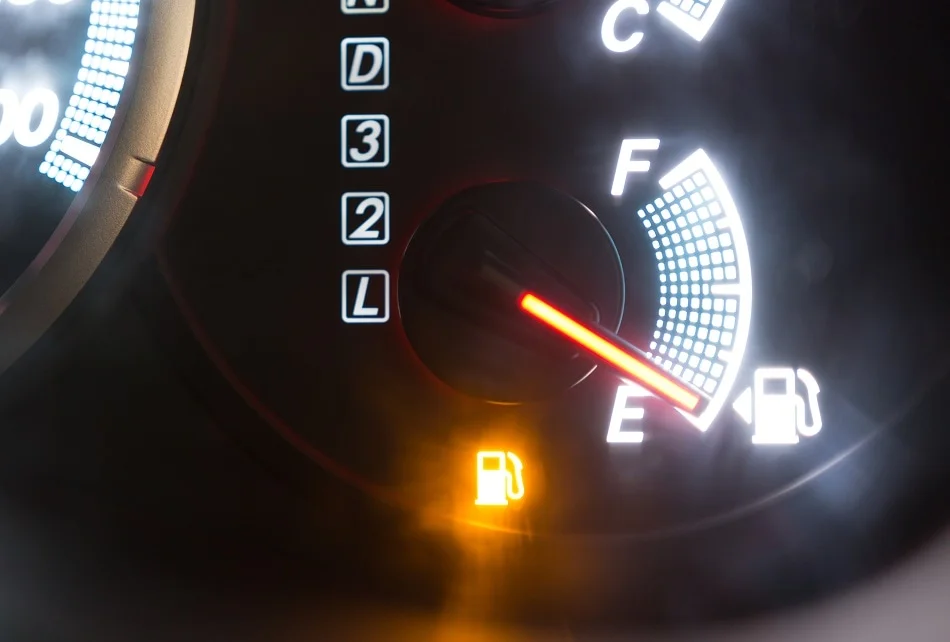
Fuel prices rise whenever global supply tightens. For countries that rely heavily on imported oil, even small disruptions in the global energy market quickly translate into higher transport costs.
While fuel prices are outside the control of individual drivers, fuel consumption is not. The way a vehicle is driven directly affects how much energy the engine must produce – and therefore how much fuel it burns.
The principles behind fuel efficiency are not guesswork. They are grounded in physics, mechanical engineering, and thermodynamics. By understanding the forces acting on a vehicle, drivers can adopt habits that significantly reduce fuel consumption.
The Physics of Fuel Consumption
When a car moves, the engine must produce energy to overcome several forces:
- Aerodynamic drag (air resistance)
- Rolling resistance from tires
- Energy required for acceleration
- Energy lost during braking
- Thermal inefficiency of the engine
Fuel consumption is essentially the energy required to overcome these forces over distance.
Understanding these forces provides practical guidance for reducing fuel use.
1. Control Speed to Reduce Aerodynamic Drag
At higher speeds, aerodynamic drag becomes the primary force opposing motion. According to the Drag Equation, drag increases with the square of velocity.Fd=21ρCdAv2
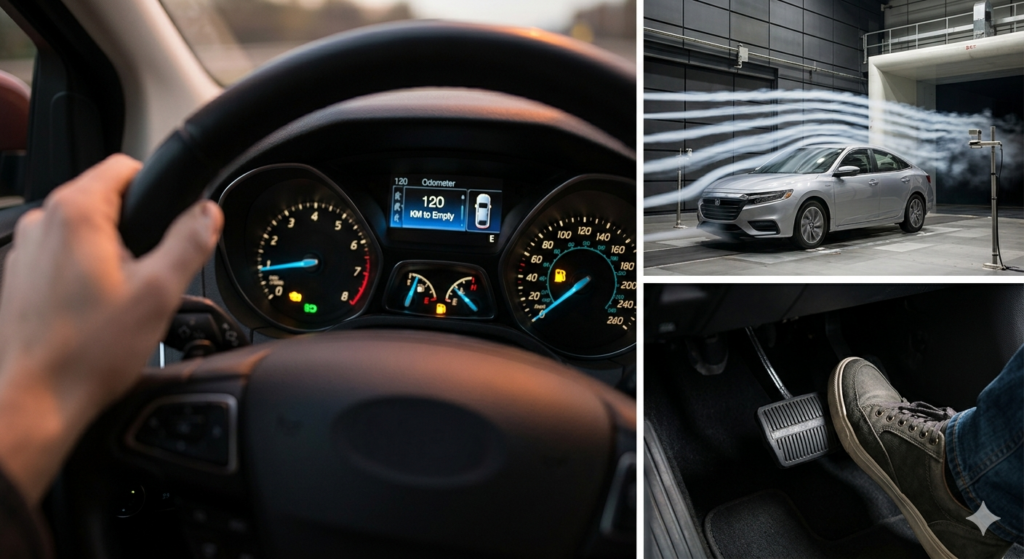
This means that increasing speed from 80 km/h to 100 km/h raises aerodynamic drag by approximately 56%. While total fuel consumption does not increase by the same percentage, the engine must still produce significantly more power to overcome this added resistance.
At highway speeds, aerodynamic drag can account for more than half of total fuel consumption, making speed control one of the most effective ways to reduce fuel use.
Practical application:
- Maintain moderate, steady speeds (typically 60–80 km/h for efficiency)
- Avoid unnecessary high-speed driving
- Use cruise control to stabilize engine load
2. Accelerate Smoothly to Reduce Energy Demand
Acceleration requires force to increase a vehicle’s velocity. This relationship is defined by Newton’s Second Law of Motion.F=ma
Where:
- F = force produced by the engine
- m = vehicle mass
- a = acceleration
Why this matters
Rapid acceleration requires the engine to generate higher torque and burn more fuel.
Aggressive driving patterns—rapid acceleration followed by braking—cause unnecessary energy expenditure.
Practical driving action
- Accelerate gradually
- Increase speed progressively instead of aggressively
- Maintain smooth throttle control
This technique is particularly effective in city driving where frequent acceleration occurs.
3. Preserve Momentum and Avoid Unnecessary Braking
A moving vehicle possesses kinetic energy. This energy is determined by the Kinetic Energy relationship.KE=21mv2
Where:
- m = mass of the vehicle
- v = velocity
Why this matters
When a driver brakes, this kinetic energy is converted into heat by the brake system and lost permanently.
The energy that created that motion originally came from fuel combustion in the engine.
Frequent braking therefore represents wasted fuel energy.
Practical driving action
- Anticipate traffic lights and slowdowns
- Maintain safe following distance
- Coast when approaching stops
Drivers who anticipate traffic flow can significantly reduce unnecessary braking.
4. Reduce Rolling Resistance from Tires
Tires continuously deform as they roll, creating resistance between the vehicle and the road surface. This force is described by the Rolling Resistance relationship.Fr=CrN
Where:
- Fr = rolling resistance force
- Cr = rolling resistance coefficient
- N = normal force (vehicle weight)
Why this matters
Underinflated tires increase the rolling resistance coefficient Cr, meaning the engine must work harder to move the vehicle.
Practical driving action
- Maintain recommended tire pressure
- Remove unnecessary cargo weight
- Use low rolling-resistance tires when replacing
Even a small drop in tire pressure can increase fuel consumption by several percent.
5. Operate the Engine Within Its Efficient Range
Internal combustion engines convert chemical energy into mechanical work, but they are inherently inefficient. Much of the energy released during combustion becomes heat rather than motion.
This behavior is governed by the Second Law of Thermodynamics, which states that energy conversions always involve losses.
Why this matters
Engines operate most efficiently within a specific RPM and load range. Operating outside this range increases fuel consumption.
Practical driving action
- Shift early in manual vehicles
- Avoid excessive high RPM driving
- Maintain steady speeds when possible
Keeping the engine within its optimal efficiency band improves fuel economy.
Putting It All Together
Fuel consumption can be simplified as:Fuel Used∝Energy Required to Overcome Resistance
Drivers reduce fuel consumption when they:
- Reduce aerodynamic drag (moderate speed)
- Minimize acceleration forces
- Preserve kinetic energy
- Lower rolling resistance
- Operate engines efficiently
These are engineering principles, not driving myths.
Conclusion
Fuel efficiency ultimately comes down to understanding how energy moves through a vehicle system.
By applying basic physics and engineering principles—controlling speed, accelerating smoothly, preserving momentum, maintaining tires, and operating the engine efficiently—drivers can significantly reduce fuel consumption.
In a time when fuel costs are increasingly volatile, these practices provide a simple but powerful advantage:
drive smarter, consume less, and maintain control over transportation costs.