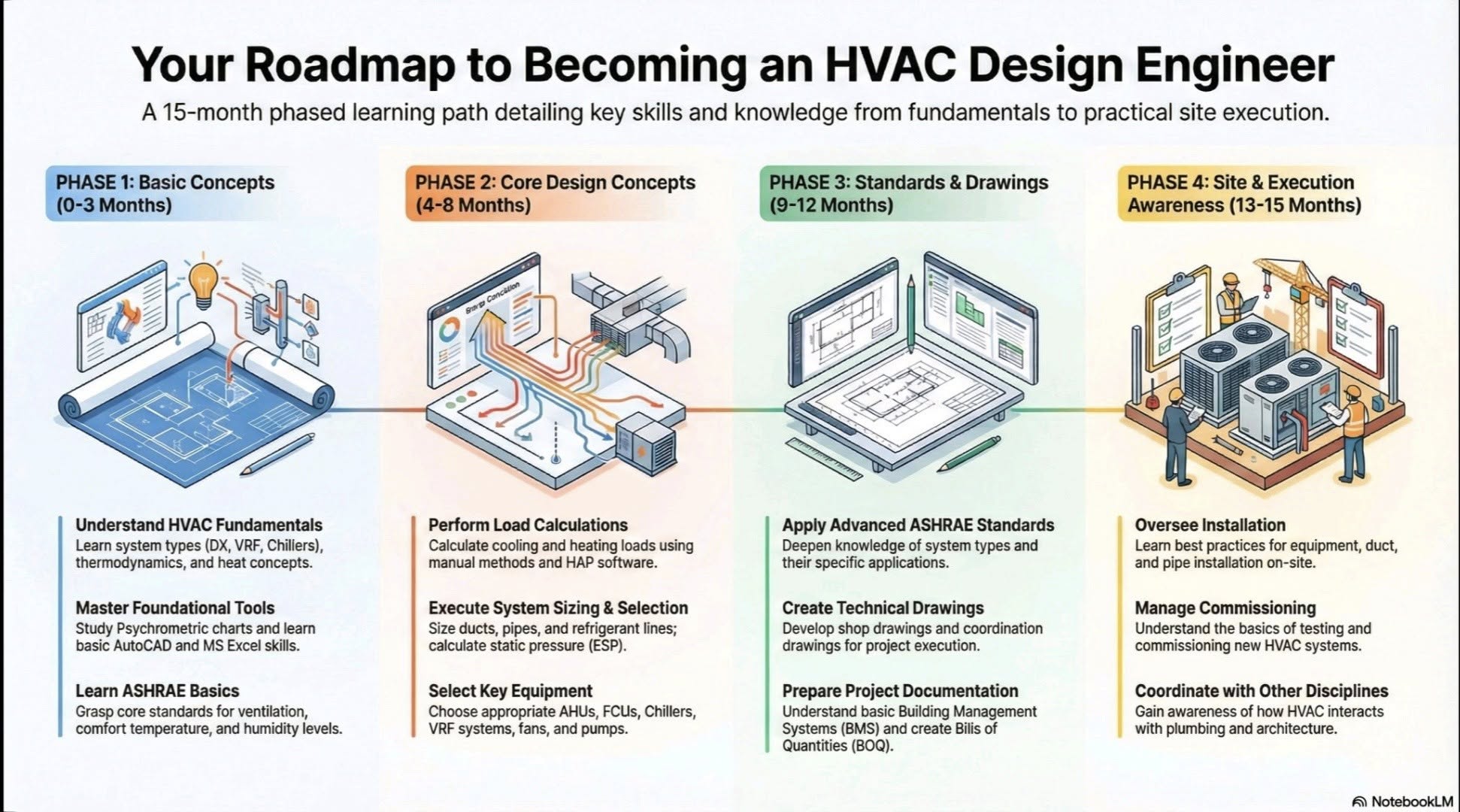
Becoming an HVAC Design Engineer today requires much more than basic thermodynamics and drafting skills, it requires an understanding of how rapid technological change is driving demand for highly specialized cooling and infrastructure solutions.
The roadmap to this career begins with fundamental HVAC concepts. Early stages focus on core system types, heat transfer principles, and foundational tools like psychrometrics, AutoCAD, and Excel — essential building blocks for any engineering design role. Learning baseline ASHRAE standards at this point ensures your work aligns with industry expectations from day one.
As you progress, the emphasis shifts toward design rigor: load calculations, duct and piping sizing, static pressure analysis, and informed equipment selection. This phase builds your analytical ability and practical judgment — the core of professional HVAC design.
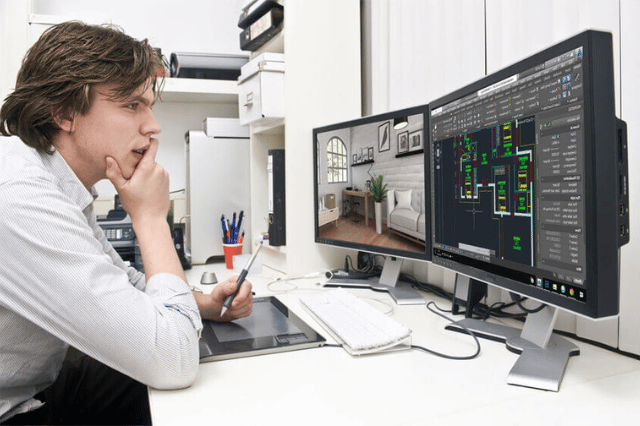
By the time you reach the documentation and standards phase, you’ll be creating coordinated technical drawings and project documentation that bring together system requirements, space constraints, and interdisciplinary integration. Proficiency here positions you to support increasingly complex projects.
Finally, site and execution awareness ties all the learning back to reality: installation oversight, commissioning, and collaboration with architects and other engineers. This bridge between design and implementation is where HVAC engineers provide measurable value and accountability.
What makes this roadmap particularly relevant right now is the significant surge in demand for data center infrastructure driven by artificial intelligence (AI). AI workloads are consuming far more compute power and generating much higher heat loads than traditional applications — and that translates directly into demand for advanced cooling design:
- Data center electricity demand is projected to nearly double by 2030, with AI workloads accounting for a growing share of total capacity — potentially half of all data center capacity by decade’s end. This rapid growth is reshaping facility design priorities around power delivery, cooling infrastructure, and energy efficiency.
- According to industry forecasts, 75% of new data center projects are now targeted at AI workloads, and nearly half of operators expect AI-optimized facilities to represent a major portion of overall data center operations within the next few years.
- The global data center cooling market, a direct downstream requirement for HVAC and thermal engineers, was valued at tens of billions of USD and is expected to expand rapidly as data centers adopt advanced cooling technologies like liquid cooling and immersion systems to manage high-density heat loads.
This growth is not abstract — it is driving real increases in infrastructure spending, power demand, and construction. Global hyperscalers and cloud providers are committing to expansive builds and upgrades, pushing the envelope on capacity while simultaneously increasing the need for specialized thermal design and commissioning expertise.
For facilities leaders and aspiring HVAC design engineers alike, this environment presents a clear opportunity: specialized knowledge in high-density cooling, advanced load modeling, and integrated system design will be among the most sought-after skills in the next decade.
This roadmap provides a structured path toward attaining those capabilities, positioning professionals to contribute meaningfully to the design and execution of modern data centers — and to lead with accountability in a rapidly evolving technical landscape.