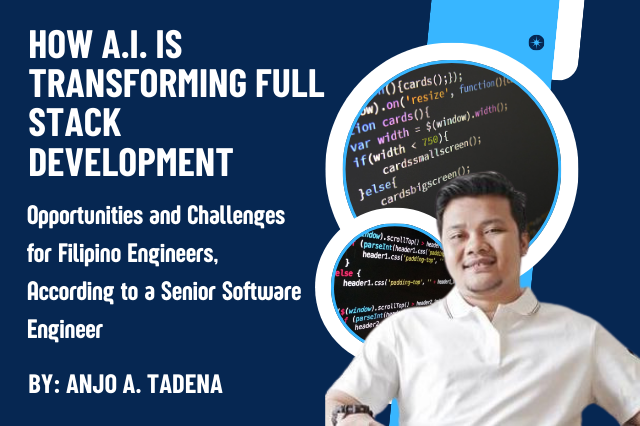
In this interview, I’m speaking with Anjo Tadena, a Senior Software Engineer with over 10 years of experience in full-stack web development. Anjo has worked on a range of exciting projects, utilizing technologies such as ASP.NET, Angular, ReactJS, and React Native. With deep expertise in both cloud platforms like AWS and Azure and various system architectures, he has seen firsthand how software development has evolved over the years. Recently, Anjo has become interested in how AI is changing the way we write software. We sat down to discuss these changes, how AI is reshaping development, and what it means for the future of the industry.
In this conversation, Anjo shares valuable insights on the growing role of AI in software development, offering practical advice on how developers can adapt to and leverage these new tools. We also explore the impact of modern frameworks like ReactJS and Angular, the evolution of cloud platforms, and the importance of scalable, efficient solutions. Whether you’re a developer looking to stay ahead of industry trends or someone interested in how AI is reshaping software development practices, this interview offers key takeaways on both technical and strategic levels.
Introduction to AI in Full Stack Development:
Can you share your experience with AI in your development work? How has it influenced your role as a full-stack developer?
Anjo: AI has really changed the way I approach development. My company has embraced tools like GitHub Copilot, ChatGPT, and AI-powered testing frameworks, which have made coding, debugging, and testing much more efficient. It’s almost like having an extra pair of hands on the job. On top of that, AI-driven features like predictive models and personalized experiences have taken our projects to the next level. It’s pushed us to think more strategically and deliver smarter, user-centered solutions, which has made my role more impactful and focused on innovation.
How would you define AI’s current role in software development, particularly in full-stack development?
Anjo: AI is definitely a game-changer in full-stack development. It helps us work smarter and faster by automating repetitive tasks like generating code, debugging, and testing—tools like GitHub Copilot and AI-powered testing frameworks really speed things up. But what’s even more exciting is how AI is being used creatively—like through predictive analytics, chatbots, and personalized features, all of which can be integrated via APIs like OpenAI or Google Cloud AI. It’s also great for things like performance optimization, auto-generating documentation, and improving teamwork. Sure, there are challenges around ethical use and keeping up with the latest trends, but at the end of the day, AI allows us to focus on solving real-world problems and building more innovative applications. It’s an exciting time to be a developer with all these possibilities!
AI Tools in Development:
What AI tools or platforms have you integrated into your development workflow? How do they assist in tasks like coding, debugging, or deployment?
Anjo: I use a handful of AI tools to speed up development and make it more efficient. For coding, GitHub Copilot, Codium, and Tabnine are game-changers. They help generate and autocomplete code, so I don’t have to waste time on repetitive tasks. When it comes to testing, I rely on Testim to automate the process and even create mock data, while Applitools ensures that the UI looks great on all devices. For deployment, AWS CodeGuru and Azure DevOps help streamline pipelines and catch potential issues early. I also use ChatGPT and Jasper for documentation and collaboration—they make it so much easier. These tools don’t just save time; they allow me to focus on creating smarter, better solutions while making development more enjoyable.
Are there any AI-powered tools you’ve found particularly useful in automating mundane tasks like code generation or testing?
Anjo: For sure! GitHub Copilot, Codium, and Tabnine are incredible when it comes to automating code generation and handling the repetitive parts like boilerplate code. For testing, Testim and Applitools are lifesavers. They automate test creation, maintenance, and even generate mock data. These tools free up so much time from tedious tasks, so I can focus on what really matters—solving problems and building better applications.
AI and Development Efficiency:
How has AI improved the efficiency of your development process? Can you share an example of a project where AI significantly sped up or enhanced your workflow?
Anjo: AI has really made my development process more efficient by handling repetitive tasks and offering smart support. For example, in a recent project, GitHub Copilot helped me generate boilerplate code super quickly and even suggested solutions for tricky logic, saving me hours of manual work. Testim was also a huge help—it automated test creation and maintenance, and even generated mock data, which made the QA process much smoother. These tools allowed me to focus on the bigger challenges and deliver results faster.
Do you think AI can eventually replace some aspects of development work, or does it still require human intervention for complex tasks?
Anjo: AI can definitely take care of the more repetitive and routine parts of development, like code generation, debugging, and testing. It makes the whole process much faster and more efficient. But when it comes to more complex tasks that need creativity, critical thinking, or a deep understanding of project requirements, AI still needs human intervention. Rather than replacing developers, AI is like a powerful assistant—it boosts our capabilities and frees us up to tackle the bigger, more strategic challenges.
Opportunities AI Brings to Engineers:
In your opinion, what are the most exciting opportunities AI offers for Filipino engineers, particularly those in full-stack development?
Anjo: AI is unlocking some really exciting opportunities for Filipino engineers, especially in full-stack development. It lets us build smarter, more personalized applications with tools for things like predictive analytics, chatbots, and AI-driven automation. AI also helps level the playing field, enabling us to compete globally by making us more efficient and allowing us to deliver innovative solutions faster. For engineers, it’s a great opportunity to upskill, explore fields like machine learning, and contribute to cutting-edge projects that actually make a difference. It’s definitely an exciting time to embrace AI and take our skills to the next level!
How can Filipino engineers leverage AI to build more innovative and scalable applications?
Anjo: Filipino engineers can make the most of AI to create more innovative and scalable applications by integrating AI tools and APIs for smarter features like predictive analytics, personalized experiences, and automation. Platforms like TensorFlow, OpenAI, and AWS AI Services offer advanced capabilities that help engineers create powerful solutions without reinventing the wheel. Plus, tools like GitHub Copilot and Testim streamline coding and testing, so we can spend more time focusing on design and scalability. By embracing AI, engineers can push the boundaries, deliver impactful solutions, and stay competitive in the global tech scene.
Challenges and Ethical Considerations:
What are some of the challenges that come with integrating AI into the development process? Are there any limitations that engineers should be aware of?
Anjo: Integrating AI into development definitely comes with its challenges. One of the biggest hurdles is the learning curve. AI tools are evolving so quickly, and it takes time to stay up to date and figure out how to use them effectively. Another issue is data quality—AI works best when the data is clean and accurate, so that’s something engineers need to be mindful of. Ethical concerns also play a big role, especially when it comes to privacy and avoiding bias in AI-driven features. And, AI tools can sometimes be like a black box, where debugging and understanding their behavior isn’t always straightforward. Engineers need to be aware of these limitations and find a balance between the benefits of AI and the need for careful planning and oversight.
AI’s Future Impact:
How do you envision AI continuing to evolve in the software development landscape? What trends or advancements in AI are you most excited about?
Anjo: I see AI continuing to revolutionize software development, making it more efficient and innovative. AI tools are going to get even smarter—helping not just with code generation but also understanding the entire project, and suggesting full solutions. AI-driven low-code/no-code platforms and automated system design are particularly exciting because they’re making development more accessible and speeding up complex projects. I’m also really excited about advancements in natural language processing and AI-powered collaboration tools. These could help bridge gaps between developers, clients, and teams, making communication and teamwork much smoother. The future of AI in development is wide open, and I’m excited to see how it’ll keep reshaping our workflows.
What skills or knowledge should Filipino engineers focus on to stay ahead of the curve in this evolving AI-driven development landscape?
Anjo: To stay ahead in this rapidly evolving AI-driven landscape, Filipino engineers should focus on mastering the fundamentals of AI and machine learning, especially in how to integrate AI tools and APIs into projects. Understanding data analysis and management is also key, since AI depends so much on clean, quality data. Engineers should also be working on their problem-solving skills and staying updated on the latest AI tools like GitHub Copilot, TensorFlow, and OpenAI. Soft skills like adaptability and collaboration are just as important to thrive in this fast-changing environment. By combining technical knowledge with a willingness to keep learning, engineers can stay competitive and continue driving innovation.
Advice for Aspiring Engineers:
For young Filipino engineers interested in working with AI in full-stack development, what advice would you give them on getting started?
Anjo: For young Filipino engineers who are excited about AI in full-stack development, my advice is to start small but stay consistent. Begin by learning the basics of AI and machine learning—there are plenty of free resources and tutorials out there. Try experimenting with tools like GitHub Copilot, TensorFlow, or OpenAI APIs to see how AI can level up your projects. Understanding how data works is also crucial because it’s at the core of AI. Work on small projects to apply what you’re learning, and don’t be afraid to make mistakes—they’re part of the journey. Most importantly, stay curious, keep learning, and build a network of peers who can help you grow and share insights along the way.
Do you believe AI is something engineers should specialize in, or is it more about integrating AI tools into existing skill sets?
Anjo: It really depends on the engineer’s goals. For most, integrating AI tools into your existing skill set is enough to stay competitive and create smarter solutions. Tools like GitHub Copilot, OpenAI APIs, and TensorFlow can really boost your productivity and creativity. But if you’re passionate about AI, specializing in fields like machine learning or data science can open up some exciting opportunities in more advanced roles. Either way, having a solid understanding of AI concepts is key, whether you decide to integrate it into your work or make it your area of expertise.
Final Thoughts:
Will AI replace developer? Why?
Anjo: AI won’t replace developers, but it will definitely change how we work. AI is great at taking care of repetitive tasks like code generation, debugging, and testing, making our workflows a lot faster and more efficient. But it still doesn’t have creativity, critical thinking, or the ability to grasp complex project requirements—the things developers excel at. Instead of replacing us, AI acts as a powerful assistant, helping us focus on solving big challenges and creating innovative solutions. Developers who embrace AI will only become more valuable in the future, as they’ll use these tools to boost their productivity, stay competitive, and tackle problems that AI alone can’t solve. With AI supporting us, we can work smarter and unlock new levels of innovation.
Looking ahead, what role do you think AI will play in the future of full-stack development, and how can Filipino engineers lead in this space?
Anjo: AI will be a key player in the future of full-stack development by automating repetitive tasks, enabling smarter features like predictive analytics and personalization, and streamlining the entire development process from coding to deployment. Filipino engineers can lead the way by embracing AI tools, constantly learning about new technologies, and combining their problem-solving skills with creativity. By staying adaptable and using AI to build innovative, scalable solutions, Filipino engineers can position themselves as leaders in the global full-stack development space.